Global Warming Poetential
Global warming potential
(GWP) is a measure of how much a given mass of
greenhouse gas is estimated to contribute to
global
warming. It is a relative scale which compares the
gas in question to that of the same mass of
carbon dioxide (whose GWP is by definition 1). A GWP is calculated over a
specific time interval and the value of this must be stated whenever a GWP is
quoted or else the value is meaningless. Calculation
Just as
radiative forcing provides a simplified means of comparing the various
factors that are believed to influence the climate system to one another, Global
Warming Potentials (GWPs) are one type of simplified index based upon radiative
properties that can be used to estimate the potential future impacts of
emissions of different gases upon the climate system in a relative sense.
GWP is based on a number of
factors, including the radiative efficiency (heat-absorbing ability) of each gas
relative to that of carbon dioxide, as well as the decay rate of each gas (the
amount removed from the atmosphere over a given number of years) relative to
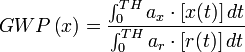
that of carbon dioxide . The Intergovernmental Panel on Climate Change (IPCC) provides the generally accepted values for GWP, which changed slightly between 1996 and 2001. An exact definition of how GWP is calculated is to be found in the IPCC's 2001 Third Assessment Report. The GWP is defined as the ratio of the time-integrated radiative forcing from the instantaneous release of 1 kg of a trace substance relative to that of 1 kg of a reference gas:
where: TH is the time horizon over
which the calculation is considered; ax is the
radiative efficiency due to a unit increase in atmospheric abundance of
the substance (i.e., Wm-2 kg-1) and [x(t)] is the
time-dependent decay in abundance of the substance following an instantaneous
release of it at time t=0. The denominator contains the corresponding quantities
for the reference gas (i.e. CO2). The radiative efficiencies ax
and ar are not necessarily constant over time. While the absorption
of infrared radiation by many greenhouse gases varies linearly with their
abundance, a few important ones display non-linear behaviour for current and
likely future abundances (e.g., CO2, CH4, and N2O).
For those gases, the relative radiative forcing will depend upon abundance and
hence upon the future scenario adopted.
Since all GWP calculations are a
comparison to CO2 which is non-linear, all GWP values are affected.
Assuming otherwise as is done above will lead to lower GWPs for other gases than
a more detailed approach would.
Use in
|
Career| Links|

© Carillon Group